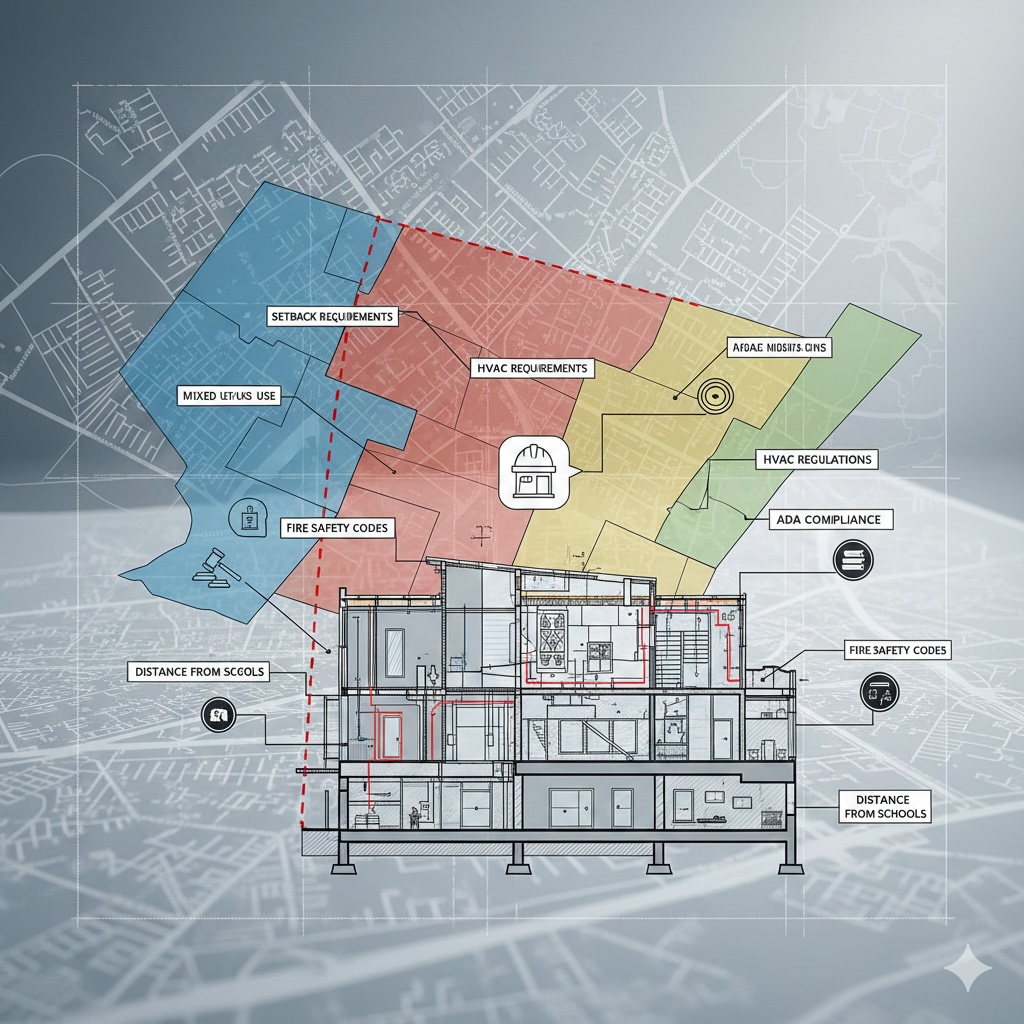
Zoning
How City Zoning and Building Codes Impact Dispensary Construction
A construction-focused explanation of how zoning rules, building codes, and change-of-use requirements shape dispensary build-outs long before construction begins.
Article Summary
- Zoning approval determines whether a dispensary can be built at all
- Building code classifications directly affect construction scope and cost
- Change-of-use requirements often trigger major upgrades
- Early zoning and code review prevents costly redesigns
Foundations
Zoning Determines If Construction Can Move Forward
Zoning is the first gate in dispensary development.
Before design or permitting begins, cities verify whether cannabis retail is allowed at a specific address.
Setback requirements, buffer zones, and overlay districts can disqualify properties that appear viable on paper.
Construction planning must begin with zoning confirmation to avoid investing in sites that cannot be approved.
Use Classification
Change of Use and Occupancy Classification
Dispensaries are often classified differently than prior retail tenants.
A change of use can trigger new occupancy classifications under building and fire codes.
These changes frequently require upgrades to fire separation, egress, accessibility, and life safety systems.
Understanding occupancy classification early helps predict construction scope and timeline.
Building Codes
How Building Codes Affect Construction Scope
Local building codes govern structural requirements, accessibility, fire resistance, and electrical systems.
Dispensary projects often require additional construction beyond typical retail due to security and occupancy standards.
Code-driven upgrades can include reinforced walls, fire-rated assemblies, and enhanced emergency systems.
These requirements impact both cost and timeline.
Fire & Safety
Fire Code and Life Safety Impacts
Fire departments play a central role in dispensary approvals.
Fire codes dictate occupancy limits, exit requirements, alarm systems, and emergency lighting.
In many cases, fire requirements are stricter for cannabis facilities than for previous uses.
Fire code compliance is often a determining factor in inspection timelines.
Local Variance
Why Every City Is Different
Zoning and building code enforcement varies significantly by city.
Two dispensaries built to similar standards can face different requirements depending on local interpretation.
Successful projects account for municipal preferences, enforcement history, and inspector expectations.
Assuming uniform requirements across jurisdictions is a common mistake.
Planning
Planning for Zoning and Code Early
Early coordination between zoning review, design, and construction teams reduces risk.
Identifying code triggers early allows operators to adjust layouts, budgets, and schedules before permits are submitted.
Dispensary projects that integrate zoning and code analysis early experience fewer redesigns and delays.
-
ZoningFirst approval gate
-
Change of UseCommon scope trigger
-
Fire CodePrimary inspection authority
-
City-SpecificCode interpretation